Buying a snowboard can seem daunting. It’s more than looking at a snowboard size chart. With all the different styles of snowboarding, brands, and technologies, it can get overwhelming to find the best snowboard for you.
That's why we've provided this guide to different types of snowboards that will show you how to narrow down snowboard sizing and the ideal board type for your specific riding style.
Riding Style and Terrain
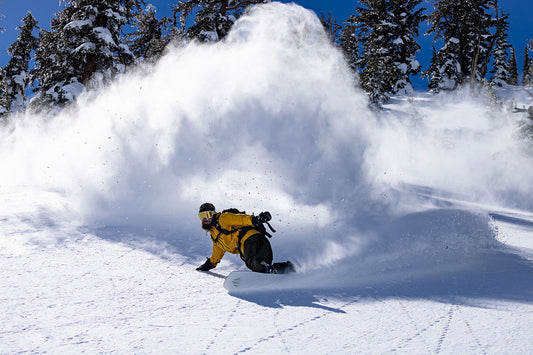
There are three main schools of riding: all-mountain, park/pipe, and freeride. These styles don't only cover how you ride but also what and where you ride. If you’re an all-mountain rider, chances are you’re boarding all over the mountain in different conditions, which means a board in the middle of your size range will be more forgiving and versatile. If park/pipe riding is more your thing, a shorter board in your size range will be easier to control for technical maneuvers. For freeride, the goal is speed and float, so a larger board in your range will give you more surface area for a smoother ride.

All-mountain boards are the most versatile boards. They're ideal for beginner to intermediate riders. All-mountain boards aren’t designed for specialized performance and are best suited for groomed runs, from the Bunny Hill to the Terrain Park. They are designed to perform well on any part of the resort or local hill.

Park/pipe boards feature performance-based designs geared toward progression and tricks. Often designed for the intermediate to expert level rider, park/pipe boards cover a variety of specialized terrain. Most park/pipe boards can be found tearing up the terrain park or cruising the hill looking for side hits. Boards in the park/pipe category have specialized technology for halfpipe, jumps, boxes, rails, and even street riding.

Freeride snowboards are typically expert level boards that require more skill and know-how, uniquely shaped for off-trail riding and floating through powder. The technology for these boards ranges from backcountry riding, to deep powder runs through the trees and back bowls, to helicopter drops down steep mountainsides.
How to Buy a Snowboard
Riding Level
Whether you’re just starting out or have been riding most of your life, your riding level can help guide your board selection process. The best snowboard for beginners falls in the middle of their size range and should be both manageable and stable while they learn. The best snowboard for intermediate and expert level riders will have an ideal size for the snowboarder's riding style and what you ride. Here are some ways to narrow that down:
Snowboard Shapes
The shape of a snowboard affects ride feel, board balance, and performance. Each shape is best suited for a specific style of riding and can help you narrow down your choices.

True twin shapes are more commonly found on park/pipe snowboards. Basically, if you cut the board in half, the nose and the tail are the same shape and equally balanced. This makes the board easier to ride switch, giving you more control no matter which direction it’s pointed.

Directional shapes usually have a distinct nose and tail and are better suited for freeride and all-mountain boards. The nose is typically larger and longer than the tail, giving the board optimal performance in one direction.

Directional twin is the ideal all-mountain shape. While there may be a distinct nose and tail on the board, its construction is completely balanced. It gives you more of a nose to help perform better going downhill in one direction, but the balanced construction means that you can ride switch, making the board more versatile than a true directional shape.

Asymmetrical shapes are relatively new to the game. These boards are constructed with a focus on the heelside and toeside edge. Because the human body doesn’t drive power to your heelside and toeside edge equally, this construction distributes power accordingly along your edges for natural control and better handling.

Tapered shapes are your deep powder surfers. With a dramatic, spooned-out nose and narrow, short tail, this shape is ideal for floating your nose above the powder and dropping your tail like a rudder for carving.
Snowboard Flex Level

What is flex and why does it matter? When you stand a board on its tail and apply pressure in the middle to flex the board, you are checking its level of flex. A board with a softer flex is more forgiving and easier to manipulate, making it ideal for beginner riders or park/pipe boards. A stiff flex on a snowboard means it performs better at higher speeds, maintaining edge control and giving you more responsive board feel.
Camber
The camber of a snowboard is the shape of its profile. This shape is important to the performance and response of your snowboard.

Camber is a very traditional board construction. It’s a super responsive and controlled shape with a slight rise between the bindings, giving you even distribution of power throughout your board.

Flat/zero camber boards lie flat on snow between the bindings. Less aggressive than a camber board but more control than a rocker, you get the best of both worlds with flat camber boards.

Rocker camber boards curve up at the nose and tail, leaving very little contact on snow between the bindings. For effortless presses and zero catch on rails, these boards have a loose, skate-like board feel.

Hybrid camber gives you a camber board between the bindings and rocker out to the nose and tail. If you want a freestyle board with more response and catch-free rocker handling, this profile is a step up in power from a flat camber board.

Hybrid rocker shapes have a rocker between your feet and camber under your bindings. This creates a serrated-like edge that holds a carve incredibly well, essentially giving you more contact points along the edge. A rocker in the middle gives you a forgiving, floaty board feel.

Powder rocker is not unlike a set-back hybrid camber shape. With an elongated rocker out to the nose for lift and float through powder and a camber rise set near your back binding, this shape is designed for powder only!

3D base is the newest kid on the block, with a slight upward bevel at the contact points in the nose and tail for a spoon shape that doesn’t catch on hard landings and floats in fresh snow. This shape is agile and progressive.
Board Tech Basics
Bindings

Most bindings will attach to any board’s binding configuration with insert discs. But there’s something to be said for getting bindings that fit your board, especially with Burton’s EST/The Channel setup. Boards with a singular sliding track for your bindings offer more board feel under your feet and the ultimate versatility in dialing in your stance.
Core Tech

All snowboards start with a wood core. Wood naturally has properties ideal for performance in snowboarding. Performance can change depending on the type of wood or how it’s laid. For example, if the wood along the edge runs perpendicular, it’ll make the edge stiffer for more hold. Fiberglass layers in the board determine how stiff your board will be and where it will flex; more fiberglass means a stiffer board.
Performance enhancers like carbon stringers can make your ride more responsive, and dampeners like rubber inserts can help reduce vibrations in the board at higher speeds so you can maintain control. Every layer of your core is created with how the board will perform in mind.
Base Material
The base of a snowboard is the P-Tex material that you wax, which comes in direct contact with the snow. There are two types of bases on a snowboard: an extruded base and a sintered base.
Extruded bases are ideal for beginner and park/pipe boards because they're the easiest to repair. The P-Tex is extruded into a sheet and built into the board. This process doesn’t hold wax as well as a sintered base, so extruded bases are a little slower on snow, but they also don’t have to be waxed as often.
Sintered bases are more commonly found on performance-focused and higher-end boards. Unlike an extruded P-Tex, the sintered base has pores that are designed to absorb and hold more wax, making the board faster on snow. Because of this, these bases need to be waxed more often than an extruded base.
Women’s Boards
What’s the difference between a men’s and women’s snowboard? Short answer: a lot, and it's worth it to consider the differences.
Snowboard technology has come a long way over the years. No longer are women’s snowboards a smaller, simplified version of men’s boards. With advances in construction, companies are now catering their board technology to the unique balance and structure of a woman’s body. Which means women’s boards are more in-tune for optimal performance for women snowboarders.
Kids' Boards
The kids out there are progressing a lot faster at a younger age. With snowboarding becoming more popular on the hill, setting up your grom to succeed is the most important thing. Get an appropriate size for maximum enjoyment. This isn’t something they can grow into: too much board will be too hard to control for the little shredders. Kids' boards are designed with little rippers in mind, utilizing technology for creating forgiving and manageable boards that will last.
Check Shred Shop's Snowboard Selection
We carry all the top brands, bringing you the latest technologies and the best selection in snowboards. Check out our products for more information or ask one of our experts if you need help finding the perfect board!